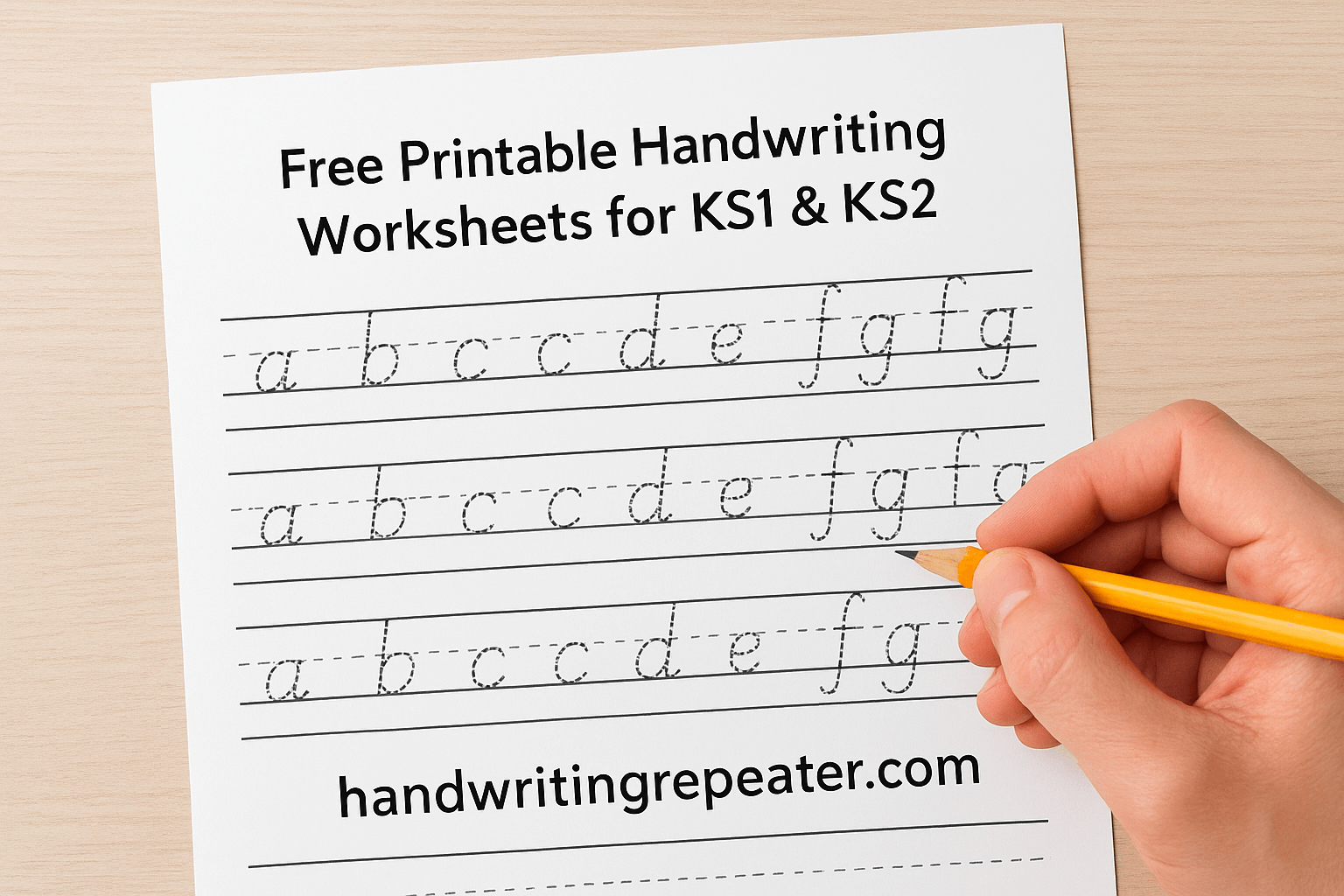
After fifteen years of watching children struggle and succeed with handwriting in UK classrooms, I can tell you that nothing beats the satisfaction of seeing a child finally “get it” that moment when their pencil glides across the page with confidence rather than uncertainty. That’s precisely why I’m passionate about sharing these free printable handwriting worksheets for KS1 & KS2 with families and educators who want to give every child the best possible start with their writing skills.
Handwriting might seem old-fashioned in our smartphone world, but it remains absolutely vital for children in Key Stage 1 and Key Stage 2. Every September, I watch new Reception children arrive with wildly different fine motor skills – some can barely hold a crayon properly, whilst others are already attempting to write their names.
What I’ve discovered over the years is that free printable handwriting worksheets UK families can access at home make an enormous difference. The children who get that extra bit of practice outside school hours consistently outperform their peers. It’s not about pushing kids too hard – it’s about giving them enough opportunities to build muscle memory and confidence.
The progression from those first shaky letter attempts to flowing Year 6 cursive writing is remarkable to witness. But it doesn’t happen by accident. It requires the right resources, proper guidance, and plenty of patient practice.
Why Handwriting Still Matters in the Digital Age?
Last year, one of my Year 4 pupils asked me why she needed to bother with “proper writing” when she could type everything on her mum’s laptop. It’s a fair question that deserves a proper answer.
Here’s what I’ve observed in my classroom: children who write fluently by hand consistently achieve better results across all subjects. When they’re not wrestling with letter formation, their minds are free to focus on complex ideas, creative storytelling, and problem-solving.
During SATs season, this difference becomes crystal clear. The children with automatic handwriting skills sail through written assessments, whilst those still struggling with basic letter formation run out of time or produce work that doesn’t reflect their actual knowledge.
There’s solid research backing up what I see daily. Children who write by hand show stronger reading skills, better spelling retention, and improved memory compared to keyboard users. The physical act of forming letters creates brain connections that typing simply cannot replicate.
I’ve also noticed something interesting about creativity. My best storytellers are almost always confident writers. When the mechanical act of writing becomes second nature, imagination flows freely onto the page.
KS1 Handwriting Skills – What Children Learn
Reception year always amazes me with its transformation. September brings children who might hold pencils in their fists or struggle to draw basic shapes. By July, most can form recognisable letters and write simple words.
The journey starts with developing proper pencil grip – something that requires constant gentle correction. I use the “pinch and flip” method: pinch the pencil tip with thumb and forefinger, then flip it back to rest in the web of the hand. Some children master this immediately, others need weeks of patient reminding.
Year 1 introduces systematic letter formation, and this is where KS1 handwriting practice sheets become invaluable. Teachers and parents can instantly create customised worksheets using our Handwriting Practice Sheet Generator, making practice both structured and engaging.
Each letter has a specific starting point and directional movement. The letter ‘a’, for instance, starts at the one o’clock position, curves round anticlockwise, then adds the descender. Getting these patterns right from the start prevents bad habits that are incredibly difficult to correct later.
I always tell parents that consistency matters more than perfection at this stage. Better to have slightly wobbly letters formed correctly than perfect-looking letters created with poor technique.
Year 2 brings the excitement of first joined writing attempts. Not all children are ready for this – some need extra time mastering individual letters. There’s no shame in taking things slowly. I’ve seen too many children rushed into cursive writing before they’re ready, creating confusion that takes years to untangle.
The key KS1 skills include correct posture (feet flat on floor, table at elbow height), proper pencil grip, consistent letter formation, appropriate sizing, and basic spacing awareness. Master these foundations and everything else follows naturally.
KS2 Handwriting Skills – Building Fluency & Style
Key Stage 2 is where handwriting truly comes alive. Year 3 children arrive with their basic letter knowledge, and I get to help them develop fluency, speed, and eventually their own distinctive style. (According to the National Curriculum in England – English programmes of study, handwriting development during Years 3 to 6 places emphasis on fluency, legibility, and adapting writing for purpose.)
Joining letters seems straightforward until you actually try teaching it. Some connections flow naturally – ‘in’, ‘an’, ‘it’ – whilst others require careful instruction. The trickiest combinations often involve letters like ‘b’, ‘o’, ‘v’, and ‘w’ that don’t connect to following letters.
KS2 cursive handwriting worksheets become essential tools during these years. They provide the repetitive practice needed to make letter joins automatic. I recommend focusing on common letter patterns rather than random combinations – words like ‘the’, ‘and’, ‘with’ appear constantly in children’s writing.
Years 3 and 4 concentrate on consistency and legibility. Children learn to maintain uniform letter height, consistent slant, and appropriate word spacing. Some develop their cursive skills quickly, whilst others need extended support. Both paths are perfectly normal.
Upper KS2 brings exciting developments as children discover their personal writing style. Year 5 and 6 pupils start adapting their handwriting for different purposes – neat presentation work, quick note-taking, creative writing. This flexibility shows real maturity in their writing development.
By Year 6, successful writers have achieved automaticity. Their hands move confidently across the page whilst their minds focus entirely on content. Watching this transformation never gets old.
Benefits of Using Free Printable Handwriting Worksheets for KS1 & KS2
Over the years, I’ve recommended countless handwriting resources to parents. UK primary school handwriting worksheets consistently prove most effective because they provide structured, systematic practice that complements classroom learning perfectly.
The convenience factor cannot be overstated. Busy parents can download quality materials instantly rather than searching shops for suitable workbooks. Teachers can quickly access resources for individual children who need extra support or challenge.
Worksheets offer something textbooks cannot: infinite repetition. If a child struggles with the letter ‘g’, you can print multiple practice sheets focusing specifically on that formation. This targeted approach accelerates improvement dramatically.
Cost matters enormously, especially for families supporting multiple children. Printable cursive practice sheets KS2 resources provide professional-quality instruction without ongoing expense. One worksheet can be used multiple times with different pencils, pens, or even laminated for dry-erase practice.
The structured format helps children understand expectations clearly whilst building confidence systematically. Model letters provide visual guides, practice lines ensure appropriate sizing, and progression follows logical developmental stages.
How to Use Our Free Printable Worksheets Effectively?
After years of observing children practise handwriting, I’ve identified several strategies that maximise worksheet effectiveness whilst keeping children engaged and motivated.
Always begin with warm-up exercises. Finger stretches, shoulder rolls, and simple pattern drawing prepare small muscles for detailed work. I use “wake up your hands” activities – finger waves, thumb touches, gentle fist clenches.
Encourage slow, deliberate tracing before independent attempts. Many parents skip this crucial step, but tracing builds correct movement patterns and confidence simultaneously. Children should trace each model letter at least three times before trying independent formation.
Keep practice sessions brief but frequent. Ten minutes daily beats hour-long weekend marathons every time. Short sessions prevent fatigue whilst building consistent habits that serve children throughout their school years.
Monitor posture and pencil grip constantly during early sessions. Correct positioning becomes automatic through repetition, but requires initial attention to establish proper muscle memory. Don’t hesitate to experiment with different pencil grips or alternative writing tools if standard approaches aren’t working.
Create a dedicated writing space with comfortable seating, appropriate lighting, and minimal distractions. This environmental support helps children focus entirely on their handwriting development rather than competing with background noise or uncomfortable positioning.
Tips for Parents & Teachers to Improve Handwriting
Supporting handwriting improvement for children UK requires patience, realistic expectations, and genuine enthusiasm for small improvements. I’ve learned that celebrating effort creates more progress than criticising imperfection.
Focus on one improvement area at a time. Instead of overwhelming children with multiple corrections, choose the most important issue and work on that consistently. Once it’s mastered, move to the next challenge.
Incorporate multi-sensory approaches that make practice enjoyable rather than tedious. Sand trays, finger paints, playdough letter forming, and air writing all support traditional pencil-and-paper work whilst adding variety and engagement.
Make handwriting practice meaningful by connecting it to real writing tasks. Thank-you letters, shopping lists, story writing, and journal keeping all provide purposeful contexts for practising newly learned skills.
Provide specific, constructive feedback that helps children understand exactly what they’re doing well and what needs attention. Rather than general comments, offer targeted suggestions: “Your ‘h’ letters are sitting beautifully on the baseline” or “Remember to curve your ‘c’ from the top.”
Remember that handwriting development varies enormously between children. Some master cursive quickly whilst others need extended practice with basic formations. Avoid comparisons and focus on individual progress journeys.
How HandwritingRepeater.com Helps?
Quality makes an enormous difference in handwriting instruction. Professional worksheet collections designed specifically for UK curriculum requirements ensure children receive appropriate skill progression through KS1 and KS2 development stages.
The systematic approach available through https://handwritingrepeater.com/ provides structured learning that builds confidence through achievable goals whilst maintaining challenge levels appropriate for different abilities. These resources understand child development principles and handwriting pedagogy in ways that random internet worksheets simply cannot match.
Professional materials save parents and teachers enormous amounts of time whilst delivering consistently better results than home-made alternatives.
If you’re preparing for class activities, you can also explore our Handwriting Competition Ideas for creative ways to motivate children.
Download Free Worksheets Now
Ready to transform your child’s handwriting journey? Access our comprehensive collection of professionally designed worksheets that align perfectly with UK primary school expectations whilst providing engaging practice opportunities children genuinely enjoy. Try our Dotted Line Worksheet Generator to create customised practice sheets that make learning even more effective.
Our complete worksheet library covers everything from basic letter formation through advanced cursive techniques, supporting children throughout their entire KS1 and KS2 handwriting development journey. Download today and start building stronger writing skills immediately.
Early intervention prevents handwriting problems from becoming entrenched habits. Quality practice materials make the difference between struggle and success.
Frequently Asked Questions
When should my child start using handwriting worksheets?
Most children benefit from structured handwriting practice once they can hold a pencil with reasonable control, typically around age 4-5. However, I’ve seen three year olds enjoy tracing activities and seven-year-olds just beginning their handwriting journey. The key is meeting your child where they are developmentally rather than following rigid age guidelines.
How often should we practise handwriting at home?
In my experience, little and often works best. I recommend 10-15 minutes daily rather than longer sessions that leave everyone frustrated. Consistency matters more than duration five days of brief practice beats one marathon weekend session every time.
My Year 3 child still struggles with basic letter formation. Should they be doing cursive worksheets?
Absolutely not yet. I see this mistake frequently parents rushing children into joined writing before they’ve mastered individual letters. Focus on perfecting basic letter formation first. Cursive writing built on shaky foundations creates more problems than it solves.
Can handwriting worksheets replace classroom instruction?
Never. Worksheets supplement classroom teaching beautifully, but children need direct instruction, feedback, and modelling from experienced teachers. Think of worksheets as homework that reinforces what’s been taught in school.
Final Words
Handwriting mastery transforms children’s entire educational experience. When writing becomes automatic, creativity flourishes, academic performance improves, and confidence soars across all subject areas.
Free printable handwriting worksheets designed for UK curriculum requirements provide families and teachers with professional-quality resources that bridge the gap between classroom instruction and home practice perfectly. These materials ensure every child receives the support they need to develop fluent, confident writing skills.
The journey from tentative first letters to flowing cursive script takes time, patience, and appropriate resources. But the investment pays dividends throughout a child’s educational journey and into adult life. Every child deserves the gift of confident, automatic handwriting that frees their mind to focus on ideas, creativity, and learning.
Want to turn typed text into beautiful handwritten notes? ✍️ Try our Text to Handwriting Tool. It instantly converts your text into neat handwriting style. Perfect for school projects, assignments, or just adding a personal touch. Quick, easy, and free to use!

The Handwriting Repeater Team builds free online handwriting tools trusted by UK teachers and parents. Our tools support the UK National Curriculum across EYFS, KS1, and KS2 — and we’ve heard directly from classroom teachers across the UK about how they use Handwriting Repeater in their daily lessons.
I love it for bunny school but how do you print it
So glad you love it for bunny school 😊
You can create your worksheet here:
https://handwritingrepeater.com/dotted-line-worksheet-generator/
After generating it, you’ll see 3 options:
• PNG – Download as an image
• PDF – Download as a printable PDF
• Print – Click this to print instantly from your device